Convert Scanned PDF to Text (Free OCR Guide)
Convert scanned PDFs into readable text using OCR. Learn how to extract text from scanned documents and make your PDFs searchable in seconds.

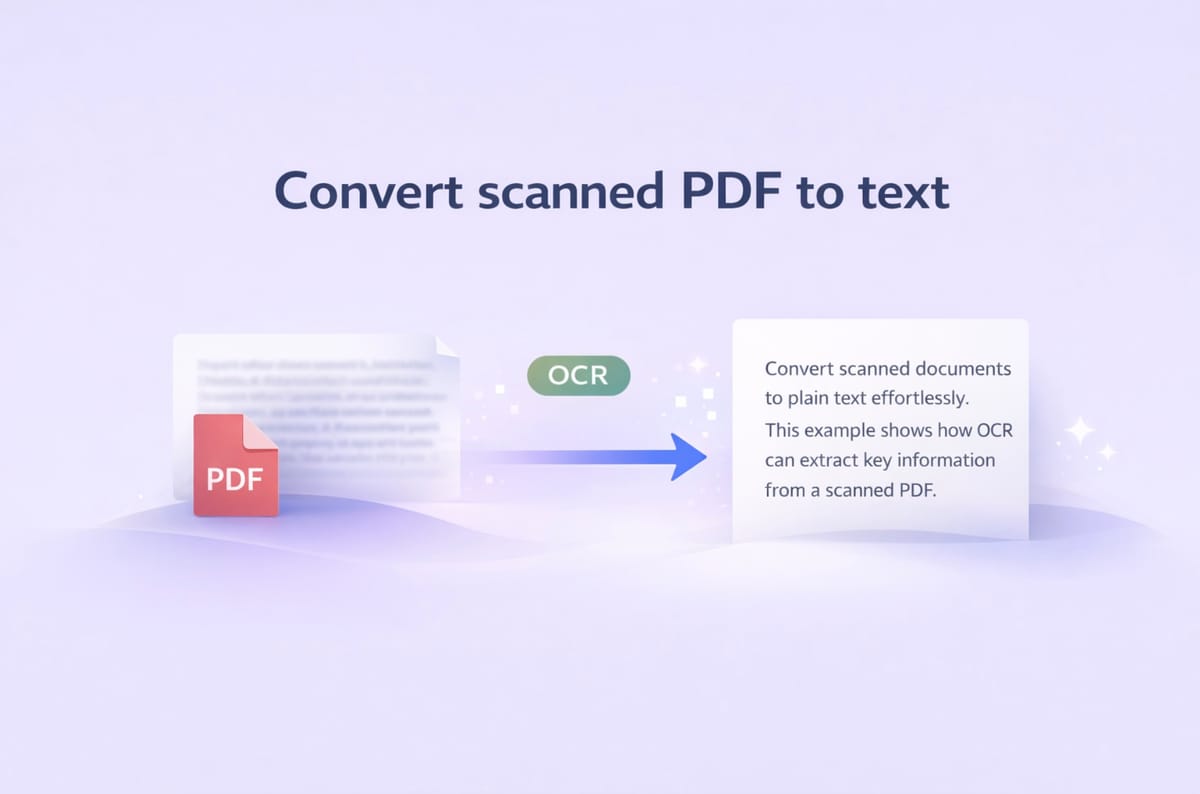
Many PDF files are actually scanned images of documents.
This usually happens when a document is created using a scanner, phone camera, or photocopier. The file looks like a normal PDF, but the text inside the document is not real text.
Instead, it is just an image of text.
Because of this, you cannot:
- copy text
- search text using Ctrl + F
- highlight words
- extract information automatically
This can be frustrating when you need to work with the document.
The solution is OCR (Optical Character Recognition). OCR technology detects characters inside an image and converts them into digital text.
Once OCR is applied, the document becomes searchable and the text can be copied or processed by software.
You can convert your document using this free OCR tool:
https://ocr.airparser.com/searchable-pdf
In this guide, you’ll learn how to convert a scanned PDF into readable text using OCR.
What is OCR?
OCR (Optical Character Recognition) is a technology that recognizes text inside images and scanned documents.
When a document is scanned, the scanner captures a picture of the page. OCR software analyzes that image and detects the characters inside it.
Modern OCR tools can recognize:
- letters
- numbers
- punctuation
- document layout
OCR works with many types of files, including:
- scanned PDFs
- photos of documents
- screenshots
- scanned receipts
- scanned invoices
After OCR processing, the system converts the detected characters into digital text.
This allows the document to behave like a normal text-based file.
Why scanned PDFs cannot be copied or searched
A scanned PDF contains images of pages, not actual text characters.
This means your computer cannot understand the content of the document.
As a result:
- Ctrl + F search does not work
- text cannot be selected
- text cannot be copied
- automation tools cannot read the document
Here is a simple comparison.
| File Type | Content |
|---|---|
| Scanned PDF | Images of text |
| OCR PDF | Image + hidden text layer |
OCR technology solves this problem by detecting the text inside the image and adding a searchable text layer to the document.
Once OCR is applied, the text becomes readable by both humans and software.
How to convert a scanned PDF to text
Turning a scanned PDF into readable text is a simple process.
The typical workflow looks like this:
- Upload the scanned PDF
- Run OCR on the document
- The system detects characters in the image
- The text is converted into digital format
- Download the processed file
The new document keeps the original layout, but the text inside becomes searchable and selectable.
You can convert your document using this free OCR tool:
https://ocr.airparser.com/searchable-pdf
Free tool: convert scanned PDF to text
The Airparser OCR tool allows you to convert scanned PDFs and images into searchable documents in seconds.
The tool uses OCR technology to detect text in your file and embed that text into the document.
The resulting PDF looks the same as the original, but it now contains a hidden text layer.
This means you can:
- search the document
- copy text
- highlight sentences
- extract information
The tool supports multiple file formats, including:
- JPG
- PNG
- TIFF
It also preserves the original layout of the document so the text remains aligned with the scanned image.
You can convert your document using this free tool:
https://ocr.airparser.com/searchable-pdf
Step-by-step guide
Below is a simple guide showing how to convert a scanned PDF into readable text.
Step 1 — Upload your scanned PDF
Open the OCR tool and upload your document.
Supported file formats include:
- JPG
- PNG
- TIFF
- BMP
You can drag and drop your file or click the upload button.
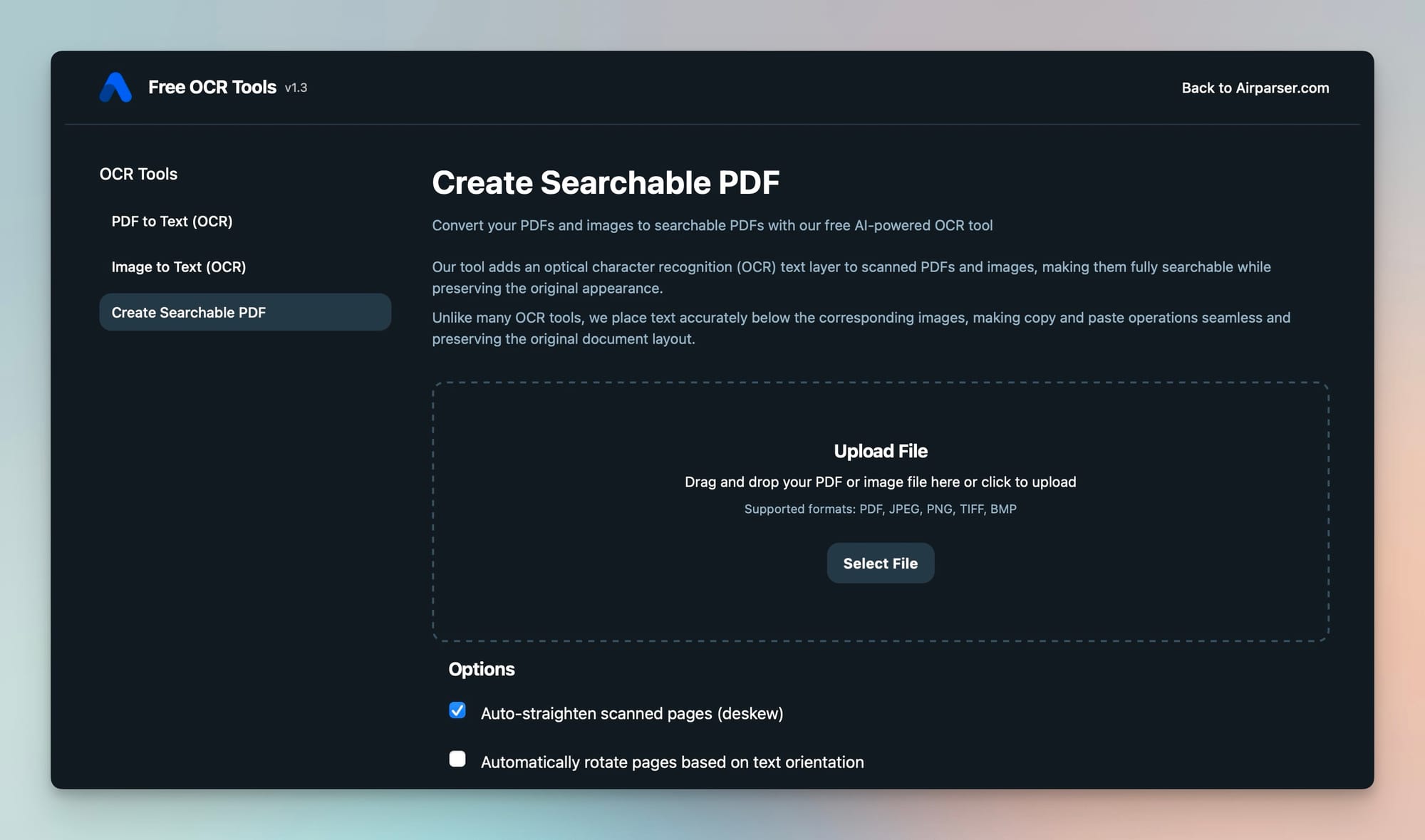
Once uploaded, the document is prepared for OCR processing.
Step 2 — Run OCR
The OCR engine analyzes the document and detects characters inside the image.
During this process, the system identifies:
- letters
- numbers
- punctuation
- document structure
The tool also includes features that improve OCR accuracy.
For example:
- Auto-straighten scanned pages (deskew) helps correct tilted scans
- Automatic page rotation detects text orientation and rotates pages if needed
These features help ensure the OCR engine reads the document correctly.
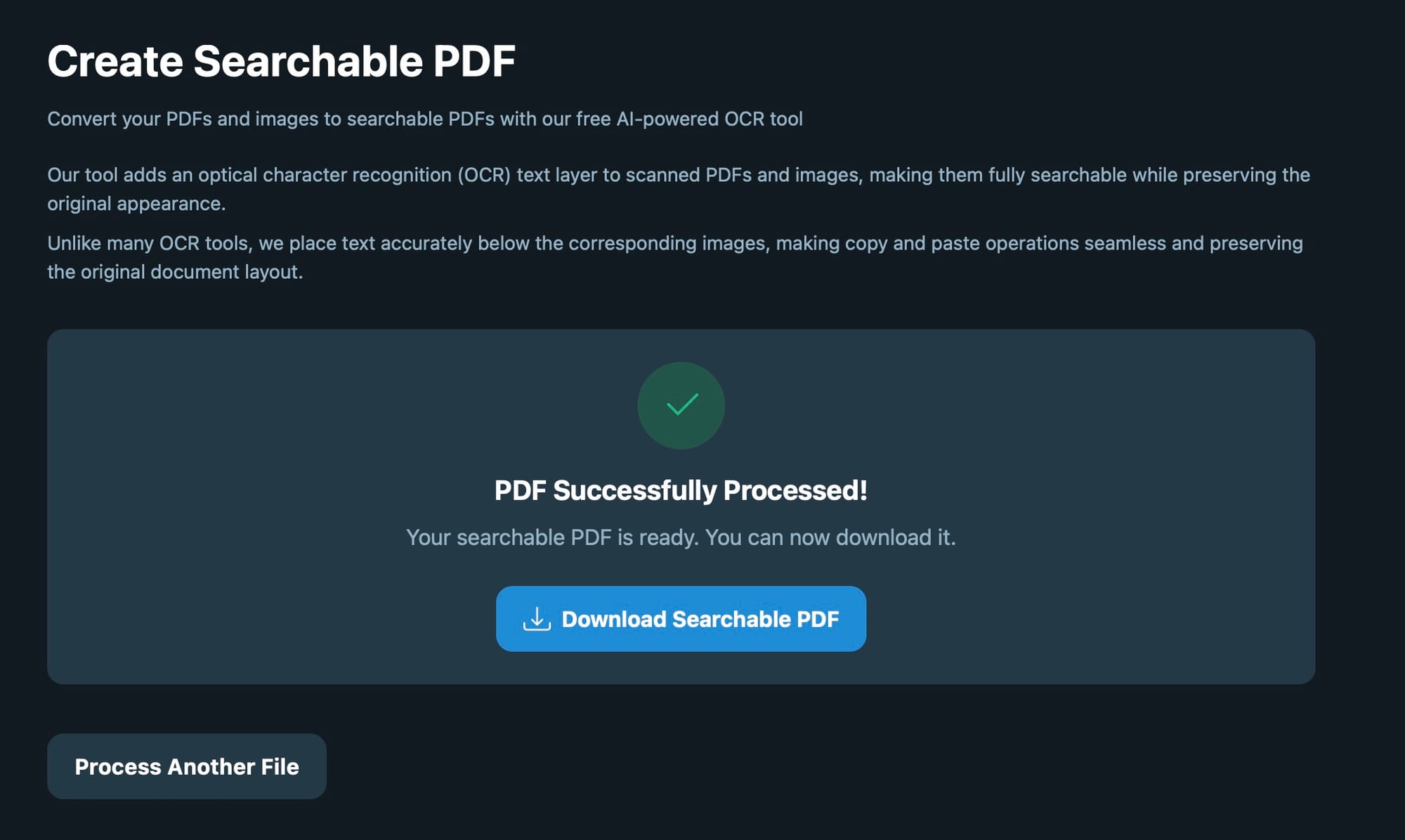
Step 3 — Download the text-enabled PDF
After processing is complete, you can download the new file.
The resulting document contains:
- the original scanned image
- a hidden text layer created by OCR
Now the document behaves like a normal text-based PDF.
You can:
- search for words
- select text
- copy and paste text
- highlight content
How to copy text from a scanned PDF
Once OCR has been applied, copying text from the document becomes easy.
Follow these steps:
- Open the searchable PDF
- Select the text using your cursor
- Copy the selected text
- Paste the text into another application
Without OCR, the document would behave like an image and text selection would not be possible.
Common OCR issues (and how to fix them)
OCR works very well in most cases, but document quality can affect accuracy.
Here are some common problems and how to solve them.
Low-quality scans
Blurry or low-resolution images make it harder for OCR software to detect characters.
If possible, scan documents at 300 DPI or higher.
Higher resolution images usually produce better OCR results.
Crooked scans
Sometimes scanned pages are slightly tilted.
This can cause OCR engines to misinterpret characters.
Deskew tools automatically straighten scanned pages before OCR is applied.
Rotated documents
Documents that are scanned sideways or upside down can affect text recognition.
Automatic page rotation detects the direction of the text and rotates the page correctly before processing.
Complex layouts
Documents with multiple columns, tables, or unusual layouts may require more advanced OCR processing.
Modern OCR engines analyze page layout to better understand how text is organized.
When OCR is not enough
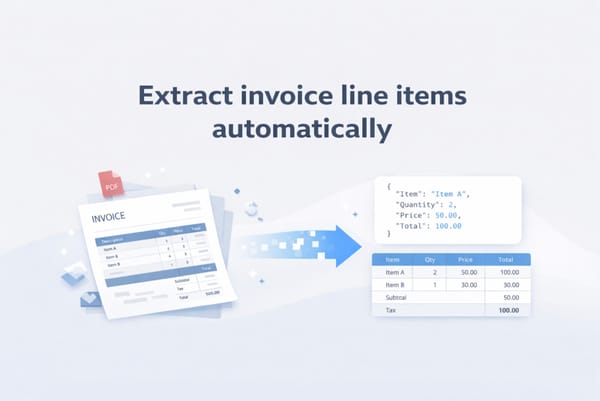
OCR converts images into text, but it does not organize or structure the information.
Many workflows require structured data extraction, such as:
- invoice numbers
- dates
- totals
- customer names
- email addresses
- order details
OCR makes the text readable, but it does not automatically extract these values.
For these use cases, you need a document parsing tool.
Extract data automatically with Airparser
If you need to extract structured data from PDFs, emails, or images automatically, you can use Airparser.
Airparser is an LLM-powered document parser that allows you to define the fields you want to extract.
For example:
- invoice number
- customer name
- total amount
- order ID
- email address
Once the fields are defined, Airparser automatically extracts the information from documents.
The data can then be sent to tools such as:
- Google Sheets
- Excel
- APIs
- automation platforms
This helps businesses automate document-heavy workflows without manual data entry.
Conclusion
Scanned PDFs contain images instead of real text. Because of this, the content cannot be searched, copied, or processed by software.
OCR technology solves this problem by detecting characters in the image and converting them into digital text.
Once OCR is applied, the document becomes searchable and the text can be copied or extracted.
You can convert your scanned PDF using this free tool:
https://ocr.airparser.com/searchable-pdf
If you later need to extract structured data from documents automatically, tools like Airparser can help automate the entire workflow.