Document Parsing and GDPR: What Compliance Actually Means for Your Workflow
Before sending customer invoices, resumes, or contracts through a parsing pipeline, here is what GDPR and the EU AI Act actually require — and what to check in any vendor.

TL;DR
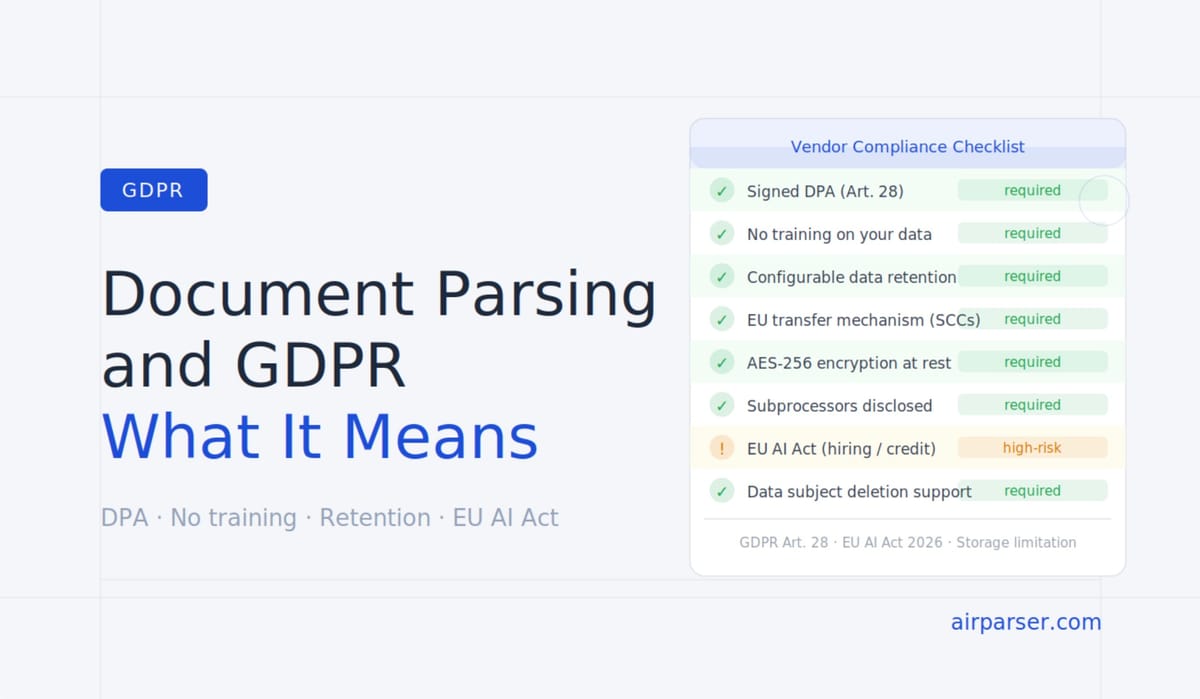
Any document you send to a parsing service — invoice, contract, resume, bank statement — almost certainly contains personal data under GDPR. Before automating your document workflows, you need to verify your vendor has a signed DPA, clear data retention controls, no training on your data, and a transfer mechanism for EU data. Raw LLM APIs (GPT-4o, Claude) create real compliance exposure if used without the right agreements in place. This article walks through exactly what to check.
When teams set up a document parsing workflow, compliance is usually the last thing on the list. The priority is getting extraction working — get the invoice data into the spreadsheet, get the resume fields into the ATS. GDPR feels like a problem for the legal team, not the person configuring the parser.
That changes fast the moment someone asks: "Where exactly does this customer data go when it leaves our system?"
If you are processing invoices, contracts, resumes, or any document that includes customer or employee information, GDPR applies to how that data is handled by every service in your pipeline — including your document parser. This guide walks through what that actually means in practice, what changed with the EU AI Act in 2026, and what questions to ask any vendor before automating a document workflow at scale.
What personal data lives in your documents
The starting point is understanding what is actually in the files you are parsing.
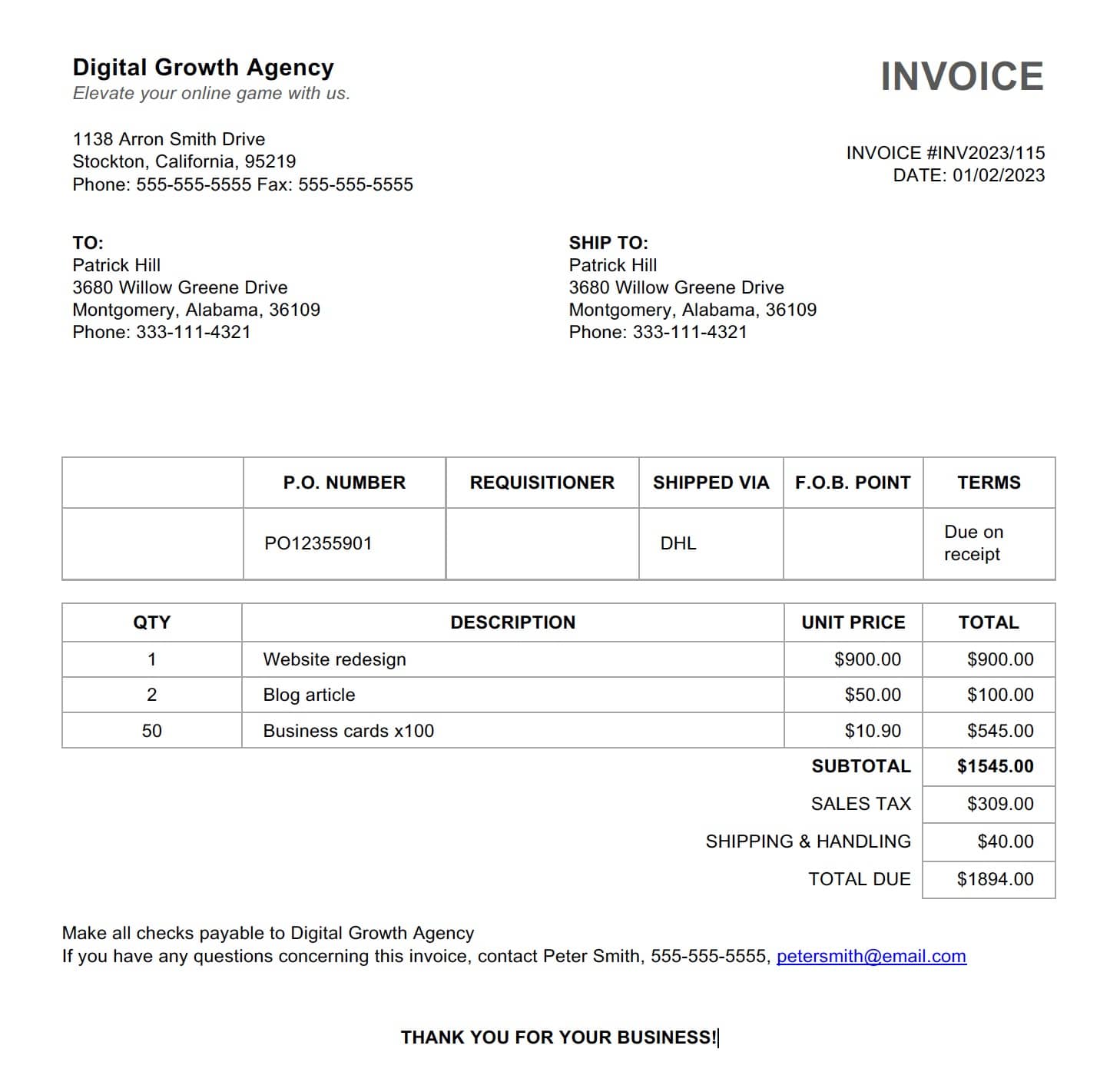
Invoices contain: customer name, company name, billing address, VAT number, IBAN or payment details, email address. These are personal data under GDPR, and in some jurisdictions financial identifiers like IBANs are treated with extra care.
Resumes and CVs contain: full name, address, phone number, date of birth, work history, educational history, sometimes health information, disability status, or nationality — several of which fall under GDPR's special category data with stricter processing requirements.
Contracts contain: signatory names, addresses, identification numbers, terms that may reveal health, financial, or employment status.
Bank statements contain: account numbers, transaction history, merchant names, recurring payments that can reveal a great deal about an individual's life.
The point is not to create a compliance checklist of document types. It is to make clear that routine business automation almost always involves personal data — which means GDPR applies, and "we are just processing a PDF" is not a legal defence.
The compliance risk most teams miss: DIY LLM APIs
Before discussing what a compliant document parser looks like, it is worth addressing the most common compliance gap teams create without realising it.
When a developer calls the OpenAI or Anthropic API directly to extract data from a document, they are transferring personal data to a third-party processor. Under GDPR Article 28, that requires a signed Data Processing Agreement (DPA) with the provider before any processing begins.
OpenAI offers a DPA, but it requires opting into specific account settings and agreeing to additional terms. The default API usage does not automatically include a GDPR-compliant data processing relationship. Anthropic similarly has a DPA available for enterprise customers, but not as a default condition of API access.
Beyond the contractual gap, raw API usage raises additional questions:
- Training on your data — does the provider use your document inputs to improve their models? Default policies vary and change.
- Retention — how long does the provider retain the content of your API requests? The answer is not always zero.
- Subprocessors — what other services does the provider use to process your data? GDPR requires transparency about subprocessors.
- Data residency — where is your data processed and stored? EU data sent to US infrastructure requires a valid transfer mechanism such as Standard Contractual Clauses.
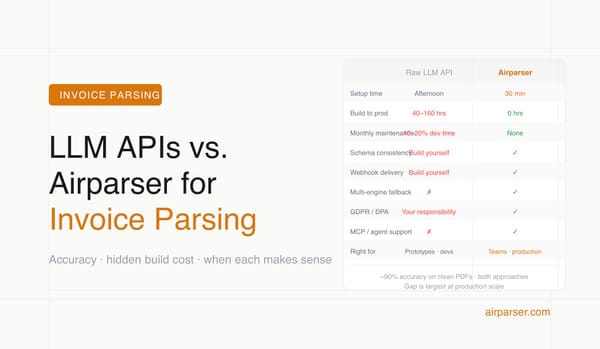
None of these are insurmountable. But they require explicit verification — not assumptions. For teams building document parsing into production workflows, using a dedicated parsing service with a clear compliance posture is often the lower-risk path than assembling these guarantees yourself on top of a raw LLM API. See also: Document Parsing: Build Your Own with GPT or Claude vs. Using Airparser.
What GDPR Article 28 requires from your document parsing vendor
Under GDPR, when you send personal data to an external service for processing, you are the data controller and the service is the data processor. Article 28 sets out what the relationship must look like.
The processor must:
- only process data on your documented instructions
- implement appropriate technical and organisational security measures
- not engage subprocessors without your authorisation
- assist you in responding to data subject requests (deletion, access, portability)
- delete or return all data when the service relationship ends
- make available information to demonstrate compliance
A Data Processing Agreement (DPA) is the contract that establishes all of this in writing. You need one in place before the first document is processed — not as a retrospective formality.
What the EU AI Act adds from August 2026
The EU AI Act entered full enforcement on August 2, 2026. It introduces an additional compliance layer on top of GDPR, not a replacement for it.
For most document parsing use cases — extracting invoice data, parsing order confirmations, pulling fields from utility bills — the AI Act's high-risk classification does not apply. Document parsing is not listed in Annex III of the Act as a high-risk AI application.
However, two important carve-outs exist:
Resume and CV parsing used for hiring decisions falls under the employment and workers management category in Annex III. If you are using AI to extract and rank candidate data that feeds into hiring decisions, this is classified as high-risk AI. High-risk systems require: risk management documentation, human oversight mechanisms, accuracy and robustness testing, and registration in the EU AI database before deployment.
Credit and financial document processing that feeds into creditworthiness assessments or loan decisions is similarly classified as high-risk.
For teams outside these categories, the AI Act still applies in terms of transparency obligations — you should be able to describe what AI is doing in your document processing pipeline if asked. But the detailed conformity assessment requirements are not triggered.
The practical takeaway: check whether your specific document type and downstream use falls under Annex III. If it does, your compliance requirements are substantially higher. If it does not, GDPR remains your primary framework.
Questions to ask your document parsing vendor before going live
Here is a practical checklist. Any vendor processing personal data in your documents should be able to answer all of these clearly.
1. Do you offer a signed Data Processing Agreement?
This is non-negotiable for GDPR compliance. If a vendor cannot provide a DPA, you cannot lawfully send EU personal data to their service.
2. Is my data used to train or improve your AI models?
The answer should be a firm no, documented in writing. This applies both to the vendor's own models and to any underlying LLM providers they use.
3. What data retention options do you offer?
You should be able to configure how long documents and parsed data are stored — ideally with options ranging from immediate deletion after parsing to longer retention windows depending on your needs. Per-document deletion on request should also be supported.
4. Where is my data stored and processed?
For EU data, you need to know whether it leaves the EU and, if so, what transfer mechanism is in place. Standard Contractual Clauses (SCCs) are the most common valid mechanism for US-hosted services.
5. What encryption standards do you use?
At a minimum: AES-256 at rest and TLS 1.2 or higher in transit. Ask specifically — "encrypted" is not sufficient as an answer without specifics.
6. Who are your subprocessors and how do you notify customers of changes?
Any service your vendor uses to process your data is a subprocessor. GDPR requires transparency about who they are and a mechanism to object to new ones.
7. How do you support data subject requests?
If a customer requests deletion or access to their data, you need to be able to respond. Your vendor should have a clear process for supporting these requests, including deletion of parsed output and original documents.
8. What happens to my data if I cancel the service?
There should be a defined process for deletion or return of all data when the relationship ends.
How Airparser addresses these requirements
Running through the checklist above against Airparser's current setup:
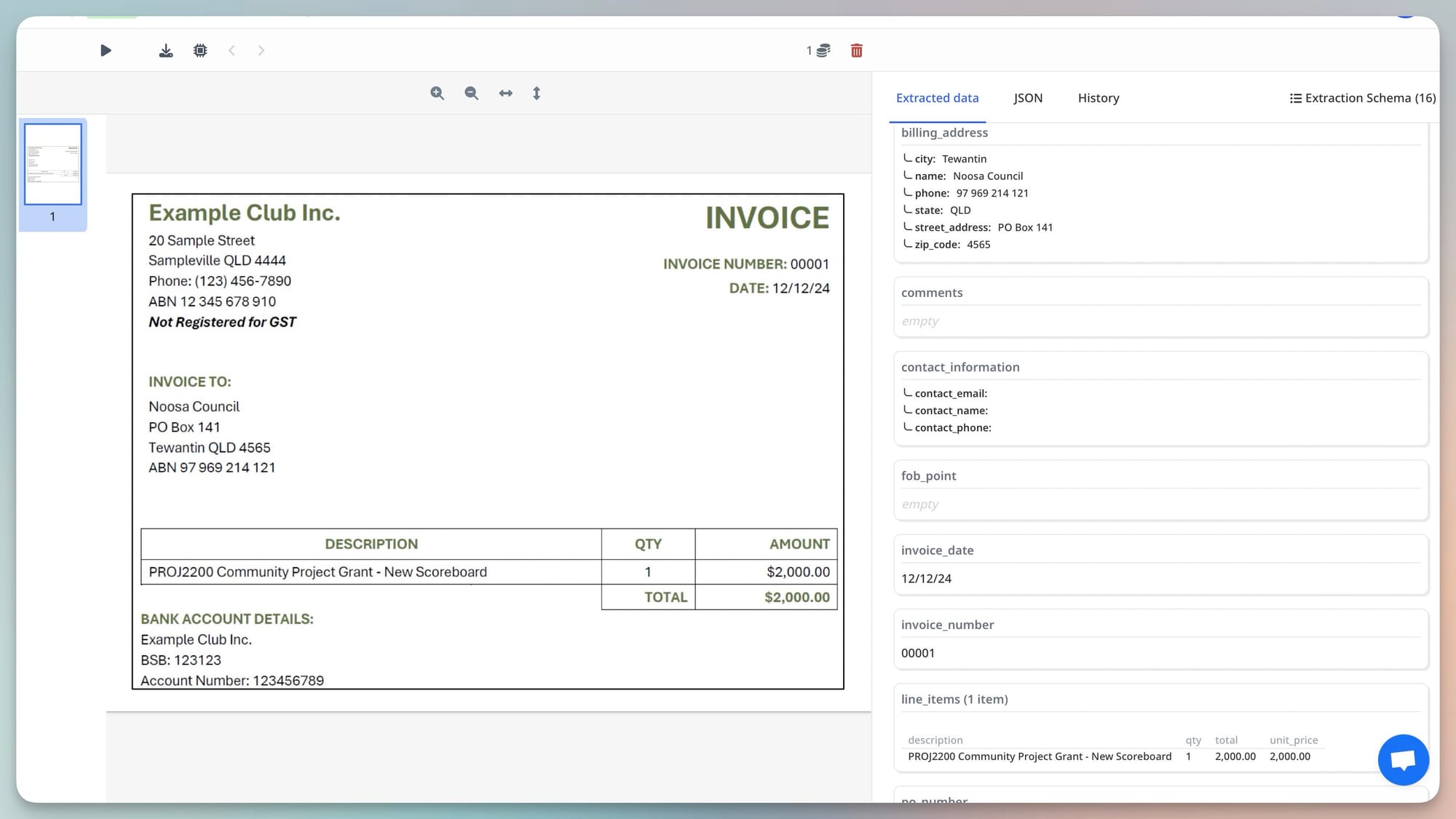
DPA — available for Business and Enterprise customers under GDPR Article 28, covering all required controller-processor obligations.
No training on your data — firm policy: documents processed through Airparser are never used to train or improve AI models, by Airparser or by its underlying model providers. This is not an opt-out default — it is the only mode of operation.
Data retention — configurable per inbox: 1 day, 7 days, 30 days, or no storage after parsing. Per-document deletion is also supported on request.
Data location and transfers — infrastructure runs on Amazon S3, Google Cloud, and DigitalOcean, primarily US-hosted. EU customer data transfers are covered by Standard Contractual Clauses.
Encryption — AES-256 at rest, TLS 1.2+ in transit, stored on encrypted Amazon S3 object storage. No document is stored unencrypted at any point in the pipeline.
Subprocessors — limited and vetted. Full list available on request.
Data subject requests — deletion supported at the document level and at the account level.
One honest gap to note: Airparser does not currently hold ISO 27001 or SOC 2 certification. For enterprise procurement processes that require one of these, that is worth factoring in.
If you want to understand the full technical setup before starting — particularly for EU workflows — create a free account and request the DPA and subprocessor list before processing any live customer documents.
Frequently asked questions
Does GDPR apply if I am only processing my own company's invoices?
It depends on what is in those invoices. If they contain personal data about your suppliers, clients, or employees — names, addresses, VAT numbers, IBANs — GDPR applies to how that data is processed. Company data alone (company name, registration number, business address) does not constitute personal data, but the moment a document contains information about an identified individual, you are in GDPR territory. Most business documents cross that line regularly.
What is a Data Processing Agreement and do I really need one?
A DPA is a legally binding contract between you (the data controller) and any service that processes personal data on your behalf (the data processor). Under GDPR Article 28, you are required to have one in place before processing begins. "In place" means signed — not just available on the vendor's website. If you send customer invoices to a parsing API without a signed DPA, you are in breach of GDPR regardless of how good the vendor's security practices are. The DPA is what creates the legal framework for the processing relationship.
Is resume parsing affected by the EU AI Act's high-risk classification?
Yes. AI systems used for employment-related decisions — including filtering, ranking, or otherwise influencing hiring outcomes — fall under Annex III of the EU AI Act as high-risk AI. If you are using document parsing as part of a resume screening or candidate ranking workflow, the high-risk provisions apply. This means you need a risk management system, human oversight mechanisms, and technical documentation demonstrating the system's accuracy and robustness. You may also need to register the system in the EU AI database before deployment. This does not mean you cannot use AI for resume parsing — it means the governance requirements are higher.
Does using a dedicated document parser reduce my GDPR risk compared to calling GPT-4o or Claude directly?
It can, but only if the parser has the right compliance posture. The key advantage is that a purpose-built parsing service typically has clear DPA terms, explicit no-training policies, configurable retention, and defined subprocessor relationships — all of which you would need to establish yourself on top of a raw LLM API. The reduction in risk comes from using a vendor who has already done the compliance work, not from the category of tool itself. A parsing service with weak data practices is no better than a direct API call. Use the checklist in this article to evaluate any vendor.
What is the minimum data retention configuration I should use for GDPR compliance?
There is no single GDPR-mandated retention period — it depends on your legal basis for processing and your purpose. The principle of storage limitation requires that data is kept no longer than necessary for the specified purpose. For document parsing workflows, this typically means: keep parsed output as long as your business process requires it, and delete the original document as soon as parsing is complete if you do not have a separate retention requirement for it. Configuring your parser to delete source documents immediately after extraction and keeping only the structured JSON output is a defensible minimisation approach for most invoice and order processing use cases.
Do Standard Contractual Clauses (SCCs) fully cover EU to US data transfers?
SCCs are a valid transfer mechanism under GDPR for data moving from the EU to countries without an adequacy decision, including the US. However, they are not a complete solution on their own — organisations technically need to conduct a Transfer Impact Assessment (TIA) to verify that SCCs provide sufficient protection given the legal environment of the destination country. In practice, most SMEs rely on SCCs without formal TIAs, which is a common approach, but larger organisations and regulated industries should be aware that SCCs alone may not satisfy all requirements under a strict interpretation of post-Schrems II obligations.