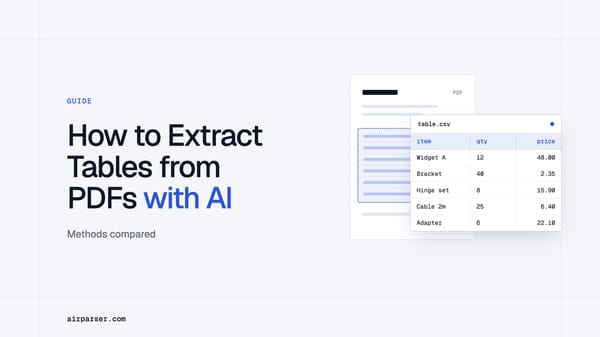
How to Extract Tables from PDFs with AI (2026 Guide)
Why tables in PDFs are hard to extract, how the main methods compare, and how to set up repeatable table extraction with Airparser, from schema tips to XLSX, CSV, and JSON export.
Why tables in PDFs are hard to extract, how the main methods compare, and how to set up repeatable table extraction with Airparser, from schema tips to XLSX, CSV, and JSON export.
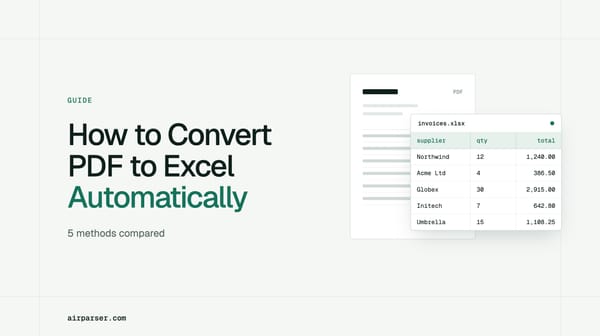
Five ways to convert a PDF to Excel, where each one breaks, and how to build an automatic PDF to Excel workflow with Airparser: define fields once, parse every document, export XLSX or CSV.
How Airparser handles document security: AES-256 encryption, configurable 1-180 day retention, no AI training on your data, and a DPA for every customer.
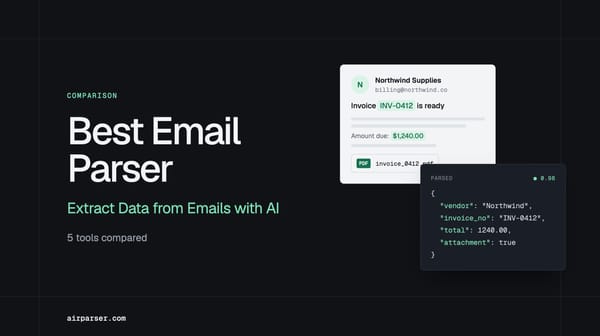
The best email parser in 2026 depends on your email variety. Airparser leads for AI-native parsing and attachments; Mailparser.io for fixed-format rule-based extraction; plus newer entrants Parsli and Lido compared.
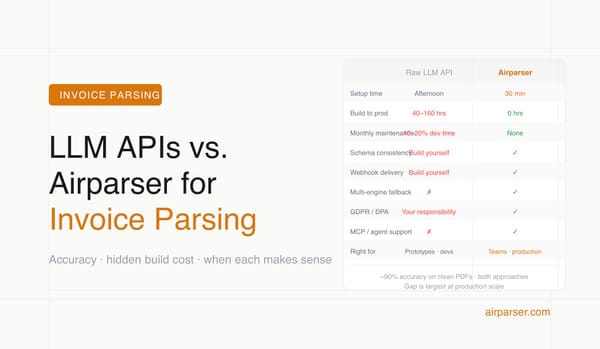
GPT, Claude, and Gemini can all parse invoices. The question is whether a raw LLM API is the right tool for a production pipeline. Covers accuracy, hidden engineering effort, and when each approach makes sense.
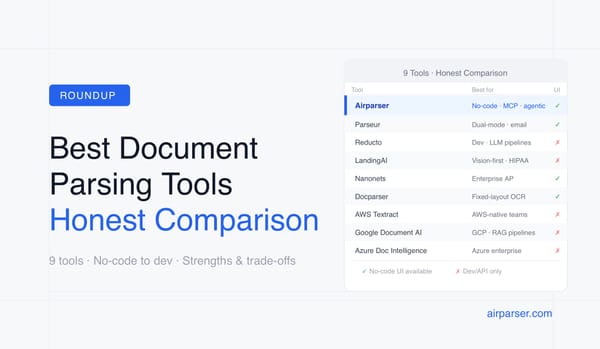
An honest comparison of 9 document parsing tools in 2026 — Airparser, Parseur, Reducto, LandingAI, Nanonets, Docparser, AWS Textract, Google Document AI, and Azure Document Intelligence. Strengths, weaknesses, pricing, and which tool fits which use case.
Email is how most business documents arrive — and the hardest input source for AI agents to parse reliably. HTML artifacts, reply chains, mixed attachments, and variable formats break naive LLM extraction. Here's how a purpose-built parser solves this.
Learn what structured, semi-structured, and unstructured documents are, how each type affects your extraction approach, and how to choose the right AI parsing method.
Shopify sends an order confirmation email for every purchase. This guide shows how to automatically extract order number, customer details, line items, and shipping address — no code or templates needed.
The best document parsing tools for property management in 2026 — Airparser, Docparser, Nanonets, Google Document AI, and DocSumo — compared for vendor invoices, leases, and maintenance work orders.
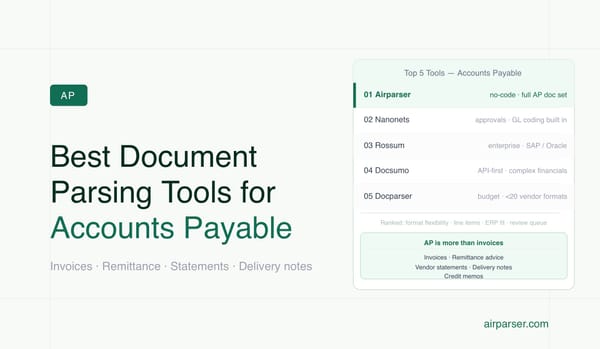
AP teams process more than invoices — remittance advice, vendor statements, and delivery notes all need structured extraction. Here are the best document parsing tools for AP teams in 2026, compared by accuracy, flexibility, and AP fit.
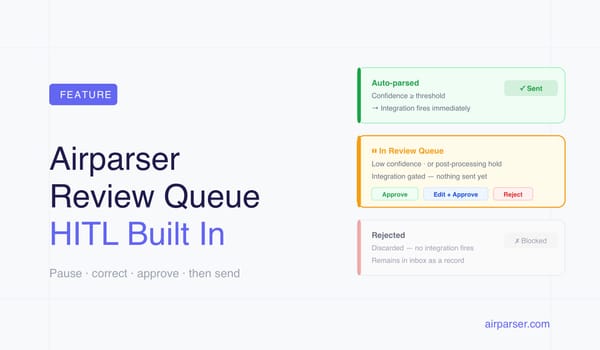
Airparser's built-in human-in-the-loop review holds low-confidence or flagged documents for approval before they reach your integrations. Here's how to set it up.
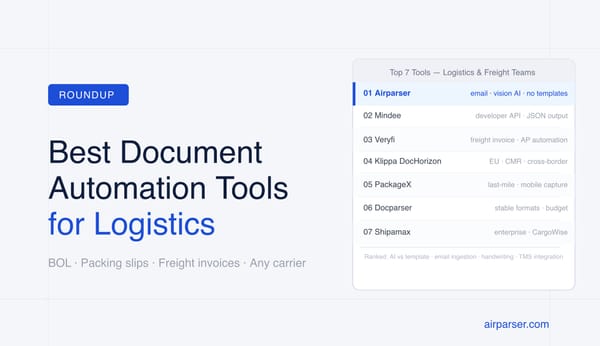
Logistics
Compare 7 AI document automation tools for logistics and freight teams — covering bills of lading, packing slips, shipping labels, and freight invoices. Find the right fit for your operation.
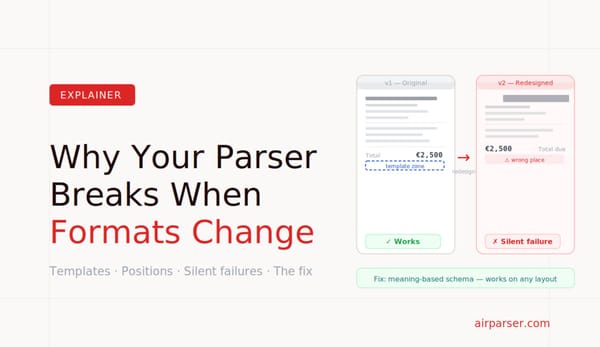
Template-based parsers use fixed positions to find fields. When a supplier changes their invoice layout, the template stops working and extractions fail silently. Here's why it happens and how meaning-based extraction solves it permanently.
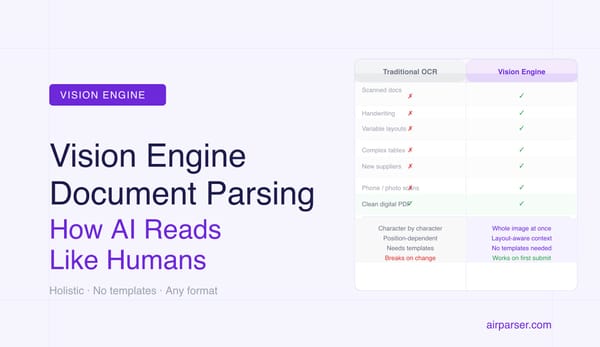
A vision engine processes a document as an image — interpreting layout, structure, and meaning the way a human reader does, not character by character. This is why Airparser can parse anything: scanned invoices, handwritten forms, complex tables, variable layouts.
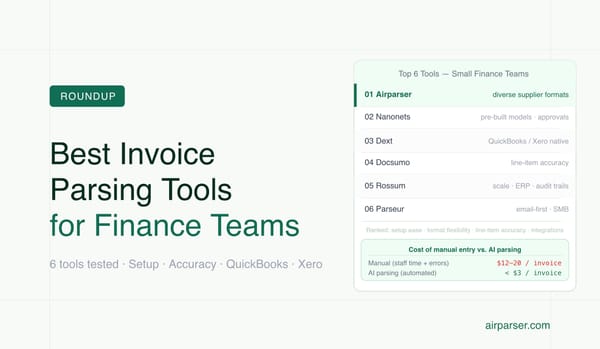
Invoice Parsing
Six AI invoice parsing tools compared for small finance and accounting teams — ranked by setup ease, format flexibility, line-item accuracy, and QuickBooks/Xero integration.
Document Automation
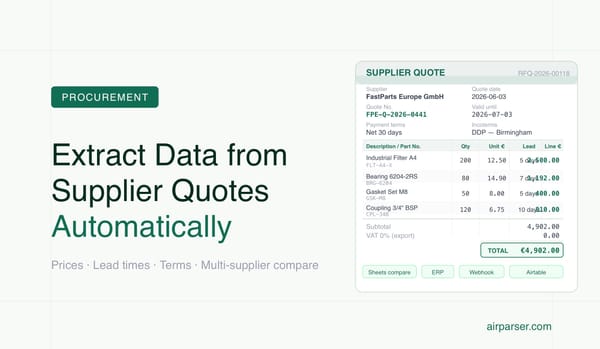
Procurement teams waste hours copying supplier quote data from PDFs and emails. Learn how to extract prices, line items, and terms automatically using AI — and send them straight to a spreadsheet or your ERP.
document-automation
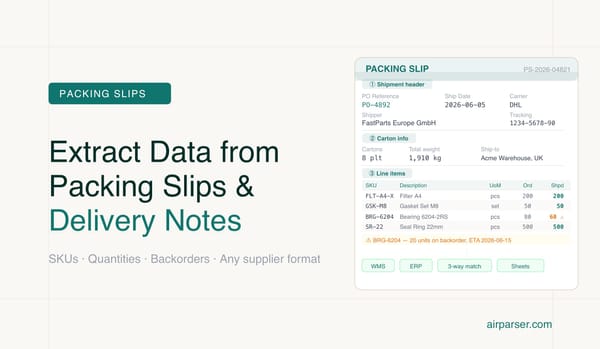
Learn how to automatically extract SKUs, quantities, order numbers, and more from packing slips and delivery notes using AI — no templates, no manual entry, any supplier format.
Logistics
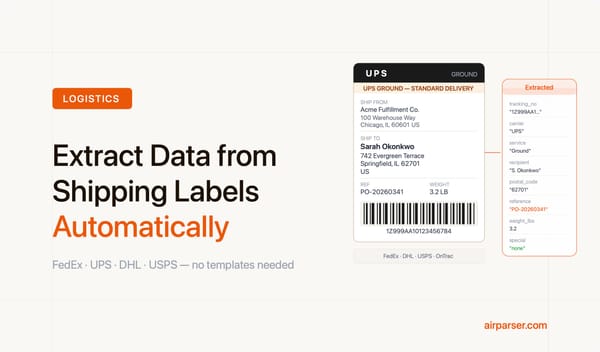
Learn how to automatically extract tracking numbers, addresses, and carrier data from any shipping label using AI vision parsing — no templates, no manual data entry, works across FedEx, UPS, DHL, and USPS.
document parsing
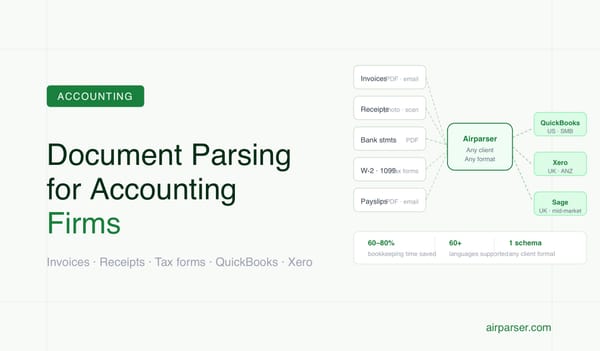
Accounting firms process invoices, receipts, bank statements, and W-2s from hundreds of clients in different formats. Document parsing automates data entry, cuts bookkeeping time by 60–80%, and handles tax season volume spikes without adding staff.
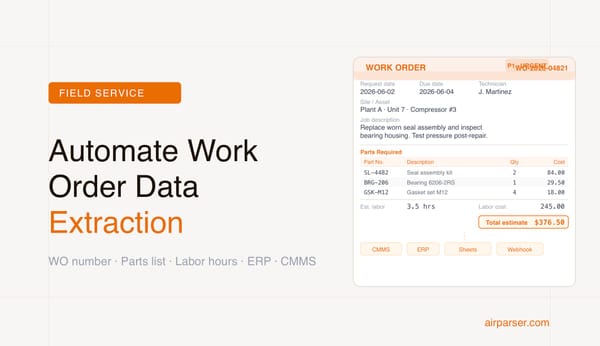
Work orders arriving as PDFs or emails lose hours to manual data entry. Learn how to extract WO numbers, job details, parts lists, and labor hours automatically — and route data to your ERP, CMMS, or spreadsheet.
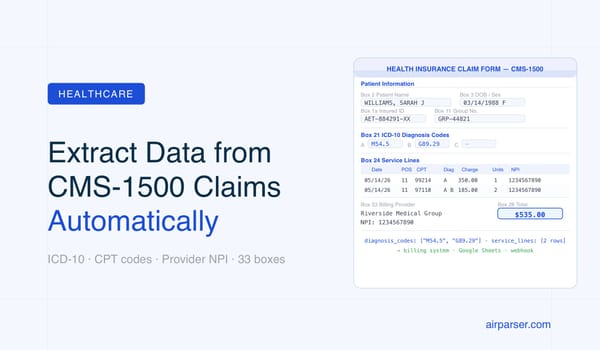
CMS-1500 medical claims forms have 33 structured boxes — patient data, ICD-10 codes, CPT procedure codes, and provider NPIs. Here’s how AI parsing extracts every field automatically and routes data to your billing system.
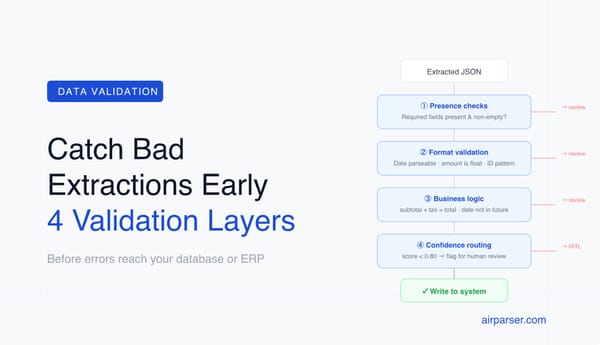
Data Validation
Extraction errors propagate into databases, trigger wrong actions, and cause downstream failures. Four validation layers — presence checks, format validation, business logic, and confidence routing — catch them before they cause damage.
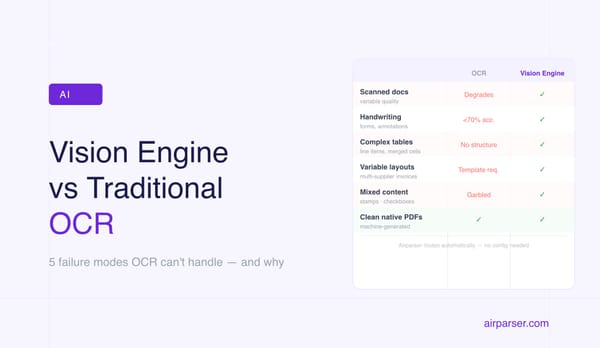
Traditional OCR fails on scanned documents, handwriting, complex tables, variable layouts, and mixed content. A vision engine handles all of these by understanding documents visually — not by reading characters more accurately, but by replacing the approach entirely.